Of course, I prefer the real deal to a model or a toy of any sort. But alas… I’m not fortunate enough to find myself actually in an airplane or out at the airport as often as I’d like. So, I’ve expectedly gathered an aviation trinket or two… or twenty.
A few of my favorites?
A plush Boeing 747 (who wouldn’t want to snuggle an airplane at bedtime?)
A shabby chic seaplane that hangs in our living room
A model FedEx Boeing 777
A vintage Eastern Airlines magazine ad
The list goes on, and on, and on.
But I recently heard about someone whose “collection” puts mine to shame – I mean really puts mine to shame.
The city of Fitchburg, Mass. boasts a hidden gem for aviation enthusiasts of all ages: Top Fun Aviation Toy Museum. I’m ashamed to admit that I’ve never even been to Massachusetts – but now I really have a reason to visit the Bay State.
The Fitchburg Sentinel & Enterprise highlighted the museum and its curators earlier this week. In a nutshell, nearly 20 years ago Deborah Scheetz earned her private pilot’s license. And at the time, her friends jokingly gifted her a number of toy airplanes to “‘make up” for not being able to give her a real plane.
Today, Scheetz and friend Rosalie Dunbar act as cocurators, volunteering their time to keep this all ages “wonder of flight” museum running. And get this – Top Fun boasts nearly three thousand aviation toys. That’s unreal!
The two friends say that it wasn’t necessarily the toy collection, but rather aviation history and a fascination with flight that inspired them to open the museum. They knew kids would be interested and curious, so they first opened Top Fun in 2000 in Winchendon. About six years later, the nonprofit museum relocated to its current spot in Fitchburg.
In addition to the overabundance of toys and the brightly painted murals, the museum’s annual “paper airplane contest” is a huge draw.
Well… I know where I’m headed when I finally make it out to Massachusetts!
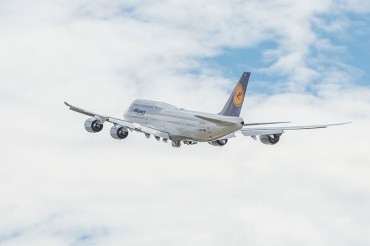
Two hundred and sixty-four days… it sounds like a long time, but I know it will come quickly. Just about eight months from now I’ll be soaring through the clouds aboard the Queen of the Skies: a Boeing 747. While it may not sound incredibly exciting to some, it will be truly monumental for me, as it will be my first time flying on one of my favorite aircraft of all time.
Sure, I love plenty of airplanes: the Boeing 377 Stratocruiser, the Lockheed L-1011 TriStar, the McDonnell-Douglas MD-11, but those aircraft, or at least the passenger versions of them, are obsolete. My only chance to fly on one of my favorite planes was to snag a ticket on a Boeing 747. And with the help of my dad, I did just that.
I’ve said it before, and I’ll say it again:
I consider only one man made “thing” on this earth to be as truly remarkable and awe-inspiring as Mother Nature herself: the airplane.
And the Boeing 747 was the inspiration behind that quote by yours truly. It’s hard not to love that plane – don’t you think?
Let’s start with how this beauty came to be. Of course the roughly 50,000 people who worked on this plane in the late 1960s are called “the Incredibles” – how could they not be given such a nickname? The engineers, the mechanics, the secretaries… they all contributed to aviation history when they seemingly “whipped up” the world’s largest civilian airplane in a mere 16 months.
The final design was offered in three different models: all passenger, all cargo, and a convertible passenger/cargo model. And I’m over the moon that my dad and I are getting to fly on the convertible model, often referred to as a “combi.”
The 747 is also the reason the largest building (by volume) was even built. The Boeing Everett Factory in Everett, Washington is where the manufacturer’s largest planes are constructed. Some equate the size of the facility to that of a city; workers even use bicycles to get around.
And it’s no wonder they had to construct that beast of a building – the 747 is huge. I work on the sixth floor of an office building in downtown Minneapolis, and knowing that if a 747 was parked on the street below, its tail would be at eye level with me, is just astounding to say the least.
While the 747’s iconic “hump” makes it so easily identifiable, the plane has been modified a number of times over the last several decades. The National Aeronautics and Space Administration (NASA) modified two 747s into shuttle carriers (the first in 1976 and the second in 1988), in 1990 two were modified to serve as Air Force One, and in 2007 Boeing introduced the “Dreamlifter” – a specially modified version of the 747 used to carry large composite structures, including fuselage sections of the 787 Dreamliner. Additional modifications over the years such as an extended upper deck and the addition of winglets on some models have continued to shape the look, feel, and functionality of the plane.
Nearly three years ago, the 747 became the first wide-body airplane to reach the 1,500 milestone, when number 1,500 was delivered to Germany-based Lufthansa. And while that was reason to celebrate, the truth is – these planes may not be around much longer. Both United and Delta airlines are retiring the jumbo jet this year, and that news was what fueled my desire to catch a ride on one while I still had the chance.
The plane is gorgeous. It’s iconic. It’s a symbol of a special era in flight. And I’m ecstatic that I’ll have the privilege to fly in one. A flight in a 747 is certainly a “bucket list” item for me, as I’m sure it is for countless aviation enthusiasts. And you can bet your bottom dollar that come November 6, when I set foot on that plane and we lift off the ground, I’ll be overcome with joy as I check that item off.
Note: This was originally published on the Aviation Queen blog, where I was fortunate enough to post as a guest contributor thanks to the immense kindness of Benét Wilson.
As one of three major U.S. airlines committed to offering travelers low-cost tickets with fewer amenities, United will soon test its basic economy fares in Minneapolis.
And while signs point toward these fares becoming a regular fixture in commercial aviation – mainly as a way for larger airlines to compete with low-cost carriers like Spirit and Frontier – flying has certainly transformed over the last several decades.
Having worked as a flight attendant for Eastern Airlines in the 1970s and 1980s, when donning more fashion-forward uniforms and serving meals on china in first class were the norm, my mom says flying was more “glamorous” back then.
But now, she says, plane rides almost feel more like bus trips, which isn’t too surprising with the rise of discount airlines, and more recently with these low-cost fares. Delta is already offering the no-frills option, and recently American announced that they’ll begin offering basic economy fares in 10 select markets starting this month.
United first announced plans to offer basic economy fares last November, and in mid-January, President Scott Kirby said they would debut at Minneapolis-St. Paul International Airport. “When you think of the number of flights coming in, the number of customers choosing United, and the airports… MSP was a great market to test this in,” United Spokesman Jonathan Guerin said.
United basic economy fares provide the same onboard experience as standard economy with a few exceptions, most notably: you can’t choose your seat and full-sized carry-on bags are not permitted. But you are allowed one personal item that you must store underneath the seat in front of you.
Brett Snyder, who runs the popular Cranky Flier blog, sees basic economy as a good way for legacy airlines to offer low fares while stripping out amenities for those who don’t need them. “While this might mean an increase in the lowest selling fare that allows for carry-on bags and advance seat assignments, those fares aren’t really sustainable today,” he said.
And it’s no surprise that basic economy has received some pushback. Senator Chuck Schumer (D-NY) recently voiced his concerns in a press release, citing the cheap fares as just another way for very profitable airlines to nickel and dime passengers. Through an upcoming FAA bill, he’ll push for new customer protections that “undo unfair policies” such as “banning” the free use of overhead bins.
The only issue is – the major airlines aren’t banning the free bin space because they’re not making you purchase a basic economy fare… it’s simply another option. These days, customers want choice and they want control, and that’s exactly what these fares are providing.
“There will always be pushback anytime the airlines do anything, even if it’s not bad,” Snyder said. “The reality is that you really shouldn’t buy these fares if you want a carry-on or a seat assignment, and the airlines will tell you that multiple times before you buy the ticket,” he added. “But people will still make that mistake and then complain.”
Another concern has been how airlines will keep track of those flying on basic economy fares. For United, Guerin said it shouldn’t be difficult, as it will be noted on your boarding pass and you’ll be in the last boarding group. This provides several opportunities for airport employees and gate agents to see if you have a full-sized carry-on, which will need to be checked and will be subject to the standard checked-bag fee. For domestic flights, you’ll pay $25 for your first checked bag and $35 for your second. But basic economy passengers who arrive at the gate with a full-sized carry-on will also need to pay a $25 gate handling fee.
United’s basic economy fares will go on sale during the first quarter of 2017, for travel during the second quarter. They’ll be available for routes between MSP and the airline’s seven U.S. hubs, eventually rolling out into other domestic markets.
Ultimately, while flying may not be the lavish experience it once was, it’s clear that the airlines have done their research in targeting this price-sensitive niche. Many people are just looking to get from point A to point B on the cheap, and now they have options outside of simply choosing a low-cost carrier.
This is the second entry of a two-part blog I did in an effort to learn more about my parents’ history in aviation. Last week, I posted about my dad’s ties to flying, from college (when his interest in aviation first began) through his careers in both the U.S. Air Force and with Eastern Airlines.
This week, we’ll learn more about my mom. She was with Eastern Airlines for about 14 years in the 70s and 80s and that’s where she and my dad met. I’ve always known how much she loved flying (and planes), but I knew there was still a lot I didn’t know about that love. She is a great storyteller with an ability to paint very vivid pictures through her words.
Enjoy!
When and how was your interest in aviation first piqued?
When I was very young, early grade school age, we lived in a rural area. Next door was a farmhouse and barn, and across the fields in the back of our house there was a small airfield. My oldest brother was often there, talking to the owner (Whitey) and the pilots, and taking an occasional lesson. I loved watching the windsock, and the planes would usually take off in the direction of our house. I loved being around my brother Steve and would often walk to the field with him. I think this is where my brother’s love of flying began.
We lived in northern Indiana, and many times planes that took off from (or were going to land at) O’Hare or Midway in Chicago, would fly over our house. I remember on cold nights being cuddled under a red and black Hudson Bay blanket in the bedroom with knotty pine walls that I shared with my brother Bob. When it was very very quiet, I could hear a distant deep hum which would grow steadily louder until I knew that the airliner was right over our house. And then I would listen until I could no longer hear even a trace of the powerful propeller sound. I imagined the people in the plane sleeping or reading; I wondered where they were going. I also wondered about the people that got to work on those planes.
What years were you a flight attendant and what was that job like? Do you have a favorite memory?
Mom as a flight attendant with Eastern Airlines
I was hired by Eastern Airlines in the fall of 1973. I went through training and after graduation my class was furloughed. We were called back in the fall of 1974 and went through an abbreviated training refresher (one week instead of the typical six weeks). I chose New York as my first base station and was with Eastern until I resigned in late 1987.
I was based in Chicago after a short time in NYC, and in Atlanta after that. Considering who I was when I started, I grew up with Eastern Airlines. I can not single out a favorite memory, there were so, so many. Being a flight attendant is a unique lifestyle, and also a very physical job. I feel like when I was working as one, there was still a small element of “glamour” attached to the job, but nothing like the years before.
What is your favorite thing about flying?
I have always loved skimming clouds… just the beauty of the clouds and the realization of how fast you are going.
What is your least favorite thing about flying?
Windy landings were my least favorite aspect of flying; I mean really windy, not just a gentle buffet now and then. Seated in the rear of the plane you could hear the throttles being adjusted, and in the front of the plane “glide slope” and the other infamous voice alarms were things I was never fond of hearing.
Tell me about the most frightening experience you ever had on an airplane.
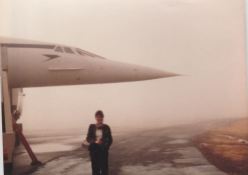
Mom in front of a Concorde
I had a few, but not one stands out as being the most frightening. Shortly after takeoff in an L-1011 from Atlanta to San Juan, I was seated at the third door back on the left. As the gear was coming up there was a very loud “BOOM!” The plane shuddered a bit and lots of overhead bins flew open. There was not a lot of communication from the crew except that we were returning to the airfield. As we were coming in, I could see emergency vehicles on the ground with their lights flashing. We landed safely, but apparently some kind of mechanism in the gear had let go.
Another one was during an overnight flight from Seattle to Atlanta. Service was done, lights were out, and passengers were sleeping. The senior flight attendant and I were sitting together in a couple of seats in first class when a loud rumbling and vibration occurred; the sound was just like the sound of something meant to slow the plane down, like the flaps or speed brake, except we were at cruising altitude. The captain came out and talked to us shortly after. He explained what had happened and his other comment was, “I almost had to change my pants with that one.”
Tell me about the most magical and/or amazing experience you ever had on an airplane.
Mom in the cockpit
So much about flying was amazing to me, it is hard to pinpoint. However, when we had an empty airplane that needed to go to another airport for positioning (a “ferry” flight), I would always accept the captain’s offer to sit in the cockpit jump seat. Takeoffs and landings up there were so exciting to me, and the view from there, with just basically the sound of the wind slipping by, was indeed magical.
Do you have a favorite model of airplane? If so, what is it and why is it your favorite?
We had six different aircraft during my time with Eastern, from the prop-jet Lockheed L-188 Electra to the Boeing 757… I loved all of them. As much as I love the sound of jet engines, the sound of the four big prop-jet engines on the Electra gave me goosebumps. The nimble little DC-9, the steady workhorse 727, all the way to the long, long 757 with the back end that would sway a bit during flight… I really did love them all.
What do you miss most about your career in aviation?
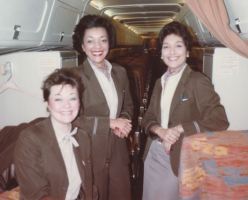
Mom with friends and coworkers Lucinda and Beverly
I miss the airplanes of course, and the crew members that I got to know, and the ability to fly almost anywhere for a minimal amount of money. Eastern was like a huge family… everyone was there because they loved airplanes and the industry. It is very sad that the company doesn’t exist anymore after such a long, proud history.
What is the most drastic change you’ve seen over the years between when you first started your aviation career and today?
Like I said earlier, I flew in the days when there was still something special about air travel. We served full meals in coach even on short flights, and served several-course meals on china and crystal in first class on longer ones. Toward the end of my career with Eastern, the “no frills” seats were starting to appear, but they were nothing like many of today’s flights that have more of a bus trip feel. Besides a seat, you got real service with your ticket when I worked for Eastern.
And that’s that. I set out to learn more about my parents’ ties to aviation, from their careers to their favorite (and least favorite) memories, and I’d say I succeeded.
As I mentioned, my mom has a way with words… everything she says and writes allows me to effortlessly envision exactly what she is referring to just like I am right there alongside her in her past.
I knew she would have great things to say about her aviation career and her love of planes, and she most certainly didn’t disappoint.




 The Great Planes